
KPIs · HVAC
What are the key performance indicators for an HVAC company?
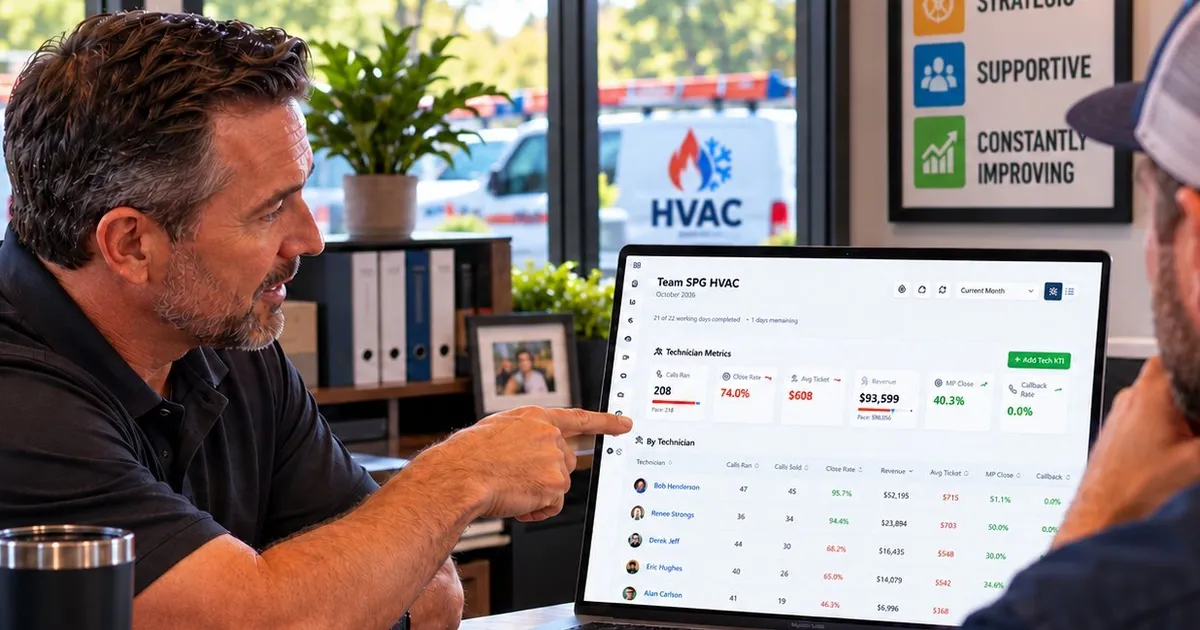
An HVAC company should track two sets of key performance indicators. For each technician: calls ran, calls sold, close rate, revenue, average ticket, maintenance plan close rate, and callback rate. For each CSR: leads, booked calls, booking rate, maintenance plan chances, and plans sold on the phone. Set a goal for each. Praise the goals they reach but focus on the goals where they underperform.
HVAC key performance indicators for a contractor, not a building
The owner of an HVAC shop with one to twenty trucks has questions. Which of my techs is making me money, and which one needs training? Which CSR is filling the schedule? Company totals cannot answer either one. The numbers below can, because every one of them belongs to a person.
The seven technician KPIs
You or your service manager enter six things per tech per day. SOS works out the rest.
- Calls ran. Opportunities dispatch sent him on. He does not control this, so it is never ranked on its own.
- Calls sold. How many turned into a job.
- Close rate. Calls sold divided by calls ran. The first number to read when revenue is low.
- Revenue. Total sales for the period.
- Average ticket. Revenue divided by calls sold. In HVAC this is where a full system assessment, and presenting more than one option, show up.
- Maintenance plan close rate. Plans sold out of the chances to sell one. In HVAC this number matters more than in any other trade. Spring and fall tune ups are what fill the schedule in the slow months.
- Callback rate. Jobs that needed a return trip. Lower is better.
Inside SOS these are called KTIs, for Key Training Indicators. They are KPIs, named for what you do with them. Every one points at a part of the service call you can train.
What each technician KPI tells you to train
The seven numbers earn their place because each red cell points at a part of the call.
When close rate is red, the tech is losing the customer at the start. He is not asking enough questions, not building a relationship, or not explaining the job before he talks price. Train the opening of the call and objection handling.
When average ticket is red, he is closing but fixing only the one thing he was called for. In HVAC that usually means a repair with no full performance and safety assessment of the system. Or he offered one option instead of three. Train the assessment on every call and three options every time: upgrade, prevent, replace.
When maintenance plan close rate is red, the plan is not being offered, or the tech cannot explain why it matters. He does not see the value himself. Train the value to the customer, then to the tech, then to the company. In HVAC this one number decides whether your spring and fall are booked before they start.
When both close rate and average ticket are red, perform a ride-along. You will find out first hand what is causing the issue. Sometimes we send technicians out in a truck thinking they have common sense. It is amazing what we assume everyone knows.
Before you pick the training, ask whether the problem is skill, mindset, or missed opportunities. A tech who cannot present three options needs practice. A tech who can and skips it because he fears objections needs a different conversation.
Counting rules that keep HVAC numbers honest
HVAC has more multi-day jobs, more deposits, and more install crews than the other trades, so counting matters more here.
- Count a job as sold on the day it is finished, not the day the deposit is taken. Deposits never go on the board, or the average ticket is wrong.
- Say a tech sells a changeout on Monday and the install crew finishes it Thursday. That is one call ran and one call sold on Thursday, with the full revenue to the selling tech.
- A changeout sold in September and finished in October counts in October.
- Two selling techs on one job: each gets a call ran, the lead tech gets the sale and all the revenue. Do not split it.
- Install crews, helpers, and apprentices are not on the technician board. You can create an install board based on revenue of installed work.
- A real callback is one call ran, no sale, and one callback against the original tech. If the return visit was not his fault and he sells more work, count it as a normal or warranty call.
- A tech who runs both service and install gets a profile in each department, with that department's goals.
The five CSR KPIs
In HVAC, call volume follows the weather. The phone rings all day in a heat wave and goes quiet in October. Your CSR (customer service rep) is the person who turns that swing into a full schedule or an empty one.
- Leads. Bookable calls: a customer asking for service, an estimate, parts, or a price. Arrival time questions, vendors, and spam do not count.
- Booked. How many got onto the schedule.
- Booking rate. Booked divided by leads.
- Maintenance plan chances and plans sold. The plan gets offered on the phone as well as in the house.
- Maintenance plan close rate. Plans sold out of those chances.
SOS tracks inbound and outbound on their own. That matters in HVAC because outbound calls are how you fill the shoulder season. A CSR who books well when the phone rings and never calls the maintenance list in April has a specific thing to work on.
Your booking goal is simple to figure. Count how many calls each truck should run in a day and multiply by the trucks. That is how many bookings the front office needs to make every day. When booked falls short, the CSR row tells you which problem you have: too few leads, or too few of them booked.
When booking rate is red, look at the call itself. The usual reasons are no conversation guide, no relationship built on the call, no assurance given, or no expectations set. Listen to a few recorded calls before you coach. When leads are short, the fix is outbound. Call the maintenance list before the season turns, follow up on open replacement estimates, and rebook the cancellations. In HVAC, the shop that makes its outbound calls in April is the shop with a full schedule in May.
Read the CSR numbers over four weeks, not one day. A sudden drop means something specific happened that week. A slow decline means a habit is slipping. A gap between two CSRs on the same phones means individual coaching, not a team meeting.
The owner's KPIs, and why they are not on this screen
There is a third set of HVAC numbers: gross margin, net profit, revenue per truck, labor percentage, materials, marketing spend. They are real KPIs and you should know yours. They are not on the technician or CSR screen, on purpose.
A tech cannot change gross margin from inside a customer's attic. A CSR cannot change your marketing spend. Those numbers are the owner's job, reviewed monthly in a budget. Putting them next to close rate makes the screen longer and the coaching conversation worse. Keep the people numbers in front of the people, and the business numbers in front of you.
Setting HVAC goals
A number without a goal is trivia. In SOS you set a close rate, revenue, average ticket, maintenance plan close rate, and callback target for the HVAC trade. If you also run plumbing or electrical, those trades get their own goals. An HVAC repair ticket and a drain call are not the same size, and comparing them helps nobody.
Start the goal from your own last few months, not from a blog table. Most published HVAC targets have no sample behind them, and some of the pages that publish them say so. Raise the goal once the team hits it. Goals have an effective date, so raising it in March does not turn January red.
HVAC reporting software vs entering six numbers
Most HVAC reporting software pulls from your field service platform and charges per user per month. That works if you run ServiceTitan or similar and want dashboards on top. SOS does not pull from anything. You or your service manager type in each tech's six numbers. Or upload a CSV, or an export from the software you already run. It is free, and every tech, CSR, and manager gets a login.
Every number then shows green or red against your goal. The rhythm after that is short. Five minutes a day on the table, looking for red and for numbers that jumped. One weekly one on one per tech, looking at his last four weeks. One goal per tech, written as a behavior he can repeat on every call, with the follow up date on the calendar. Sort by close rate, find the red, and that tech is Monday's ride along.
The KPIs page shows the screen. The TV Leaderboard puts the same numbers in the break room.

Related questions
Why does SOS call them KTIs instead of KPIs?
A KPI is any number a business watches. Inside SOS the technician and CSR numbers are called KTIs, Key Training Indicators, because every one of them points at something you can train. Same numbers, named for the job they do.
How many KPIs should an HVAC company track?
Seven per technician and five per CSR, each against a goal. Keep the owner's numbers, such as gross margin and revenue per truck, in the budget where you review them monthly. An owner with twenty numbers on one screen reads none of them.
Do install technicians go on the board?
Not normally. We have seen some owners create a separate install board that counts the amount of revenue installed. Install crews are not on the technician board. When a service tech sells a changeout that installers finish later, the sale counts for the selling tech on the day the job is done. That is how you see missed opportunities without punishing the installer.
What is a good close rate for an HVAC tech?
Set it from your own last few months and raise it when the team gets there. A target copied from a blog has no sample behind it. Team SPG publishes medians from coached shops only when it makes sense. HVAC KPIs are very different shop to shop. <!-- CTA component: sos (id: sos-signup), utm_campaign=sos-kpis. Set as the per-article override at import. Internal links: pillar /sos/kpis/; siblings /sos/kpis/kpi-software/, /sos/kpis/business-dashboards/ (link once published); feature /sos/leaderboard/. Row note: the registry row has format = benchmark and the primary keyword's live SERP is facility-management intent (see row 68 notes). This draft is written as a how-to with no numbers so it can ship now; the frontmatter sets format: how-to and the import will overwrite the row. If the primary is re-pointed to a contractor-intent keyword, update primary_keyword, slug, seo_title, and the first H2 before import. -->