Scalability
How do I break through the 5-truck hump in my electrical business?
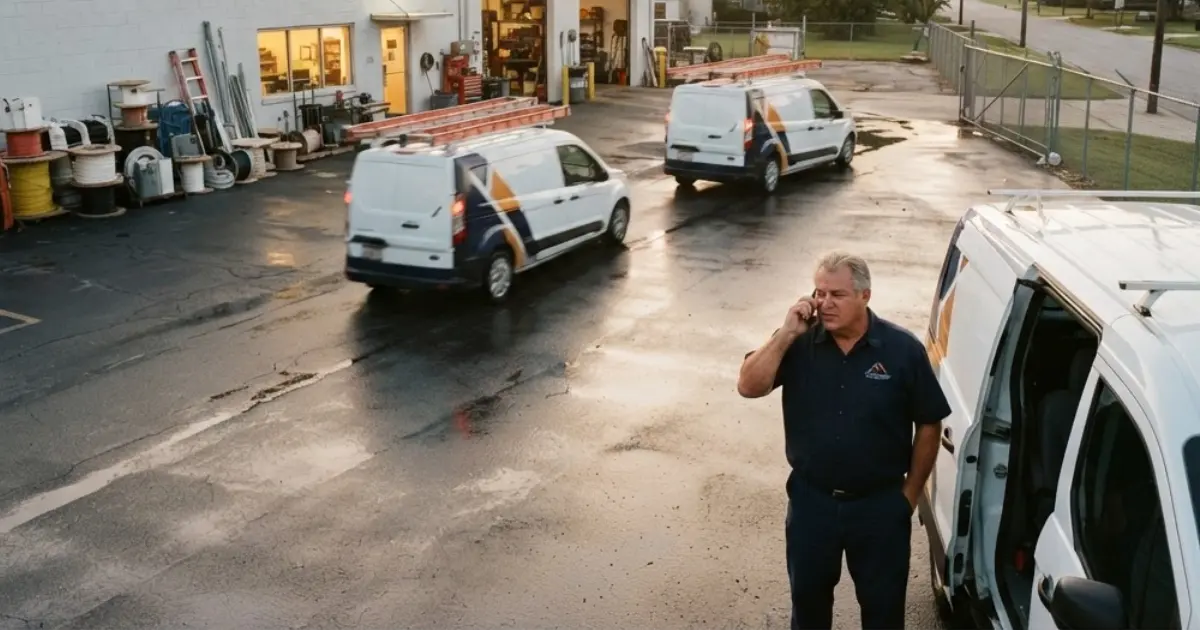
You grow to four or five trucks, almost hire a service manager, lose two technicians, and slide back to where you started. Again. The 5-truck hump in an electrical business isn't a mysterious market force. It's what happens when growth outruns recruiting, and when the sales process still lives in one person's head. The shops that clear it get ahead on recruiting instead of scrambling after every resignation, and they get the whole team running one sales system before they spend another dollar chasing leads.
Why shops bounce here
At this size you're past the "owner does everything" phase of the under-$1M ceiling. But you haven't built the layer that makes growth stick yet. You need a bench of technicians and a sales process the team has actually been taught before a service manager can hold the seat.
The pattern we see on repeat:
- Growth spurt. Your booked-out window stretches, so you hire, and revenue climbs.
- Attrition hit. One or two techs leave. Maybe three in a bad month. Capacity collapses overnight.
- Reset. You're back on the tools, the service-manager hire gets postponed, and next year's budget gets rewritten to match last year's.
You've heard "always be recruiting." Most owners believe it right up until the doomsday month, when it becomes real: the job ads were closed, the pipeline was empty, and now you're starting from scratch while the phone keeps ringing.
1. Recruit ahead of the wall, or every resignation owns you
The shops that clear five trucks treat recruiting as a permanent system, not a panic button. That doesn't mean hiring every warm body. B and C players brought in to "fill the seat" usually cost more than the empty truck did. It means the pipeline never stops, and when an A-player shows up, you find a way to get them on the team.
We've coached owners through the cycle: grow, lose people, grow, lose people, almost ready for a service manager, lose people again. The ones who finally break through didn't invent a new trick. They kept candidate flow on even when the roster looked full, hired good people knowing some would churn, and eventually held a crew stable enough to put a manager over it. After every resignation the question is simple: are you restarting, or are you ready to keep going?
Under a million, this can mean keeping A-players on a short list and hiring the ones you can't afford to lose. At five trucks, it means the ads stay open and interviews don't wait for a crisis. Playing from behind on labor is how a growth year turns into a flat year.
2. Reinstall the sales system, especially after you lose people
Five trucks with everyone "doing their own thing" is how you get busy and broke at the same time. We've seen shops where the technicians looked productive, with high average tickets and plenty of leads, while every tech on the roster closed below 50%. They weren't running a process. They were swinging for the fences.
One owner's wake-up call came the hard way. When he finally put the numbers on a board instead of keeping performance in his head, the gap was obvious. Small coaching changes started to help. Then attrition hit and he had to go back into the field himself. Running two to three calls a day his way, he closed near 75% and produced like a top tech. The lesson wasn't that he was magic. It was that nobody else had ever been taught the system he expected them to run. And at six calls a day, they wouldn't have had time to run it anyway.
He came back, retaught the team that remained, and held them accountable to the same structure. Accountability wasn't a speech. It was close rates on the board every day, ride-alongs when a number slipped, and a deadline attached to improvement. Teaching the system gets you a good week. Tracking it is what gets you a good year. A young technician on that rebuilt crew hit the same close-rate band and the same production level, because the process was finally taught instead of assumed.
If your techs close at half your rate, you don't have a lead problem. You have an untrained sales team. Put the call structure back in place (diagnose out loud, present options, ask for the work), track close rate per tech daily against the coached-shop median of 65.7%, and treat a soft closer as a coaching assignment with a deadline, not a permanent personality.
3. Stop thinking more leads will solve the problem
At this hump, the industry's default language is still "we need more calls." Look at the data first. Most companies don't have a lead problem. They have a conversion problem, and they make it worse by stacking four, five, or six runs on a tech who never has time to diagnose and present options.
Two to three quality opportunities, run properly, beats a packed board of half-sold tickets. The same owners who overload the schedule are usually the ones buying more marketing because the trucks aren't converting. Fix the process and the call load first, then add capacity. A new truck at a soft close rate just scales the leak. At the coached-shop median, a producing tech generates $357K per year. Five underperforming trucks isn't growth. It's a margin problem wearing a headcount costume.
What the service-manager seat actually requires
You don't hire a service manager to fix chaos. You hire one when the trucks are stable enough that the job is leading people who already run a system, not babysitting freelancers in matching shirts. Before the seat can work, a few things have to be true:
- Recruiting never fully turns off
- One sales process, with close rates scored daily
- Office and dispatch rules that don't route every exception to you
- A call load techs can actually win at
Until those are true, every "almost ready for a manager" moment is temporary. Attrition will prove it.
What we recommend
Sequence the hump the same way you sequenced the first million, just with harder consequences when you skip a step:
- Numbers on the wall this week. Close rate, average ticket, maintenance-plan conversion, callbacks, and revenue per day, tracked per tech.
- Install your sales system this quarter. Teach it, ride along on it, and re-teach it every time the roster changes.
- Recruiting always on. A-players get a seat. Seat-fillers don't. The ads don't close because "we're full."
- Set the call load for conversion. Two to three quality runs beats six drive-bys.
- Hire the service manager when the crew holds. Not when you're lonely on the tools.
If you want a clear read on whether your bottleneck is people, process, or both, take the free scale-readiness assessment. It's short, no account required, and it shows you where the leak is.
65.7%
Electrical close rate (median)
Team SPG coached-shop data · trailing 12 months ending July 2026 · updated Aug 2026
$357K
Electrical revenue sold per tech per year (median)
Team SPG coached-shop data · trailing 12 months ending Sep 2026 · updated Sep 2026

Related questions
What is the 5-truck hump?
It's the growth stall where an electrical shop gets almost big enough to support a service manager, then loses technicians and slides back. The cause is usually recruiting from behind, plus a sales process that was never fully installed in the team.
Should I always be recruiting at five trucks?
Yes, with judgment. Keep the pipeline open and hire A-players when they appear. Don't hire B and C players just to fill seats. The shops that bounce at five trucks almost always closed the ads when things felt full.
How many calls should each electrician run per day?
Two to three quality opportunities if you want them to close. Four or more rushed calls is how you manufacture a "lead problem" while wasting the demand you already paid for.
Is this different from scaling past $1M?
Related, but a different ceiling. Past $1M the fight is replacing the owner as the bottleneck. At five trucks the fight is keeping enough trained, converting technicians that growth doesn't reset every time someone quits, and earning the right to put a manager over the crew. <!-- CTA component: assessment, trade=electrical. Suggested copy angle: "Stuck bouncing at five trucks? See which section of the business is actually capping you — free electrical assessment, section-by-section scores, no account required." -->