Revenue & Performance
What should my billable hour rate be? (HVAC)
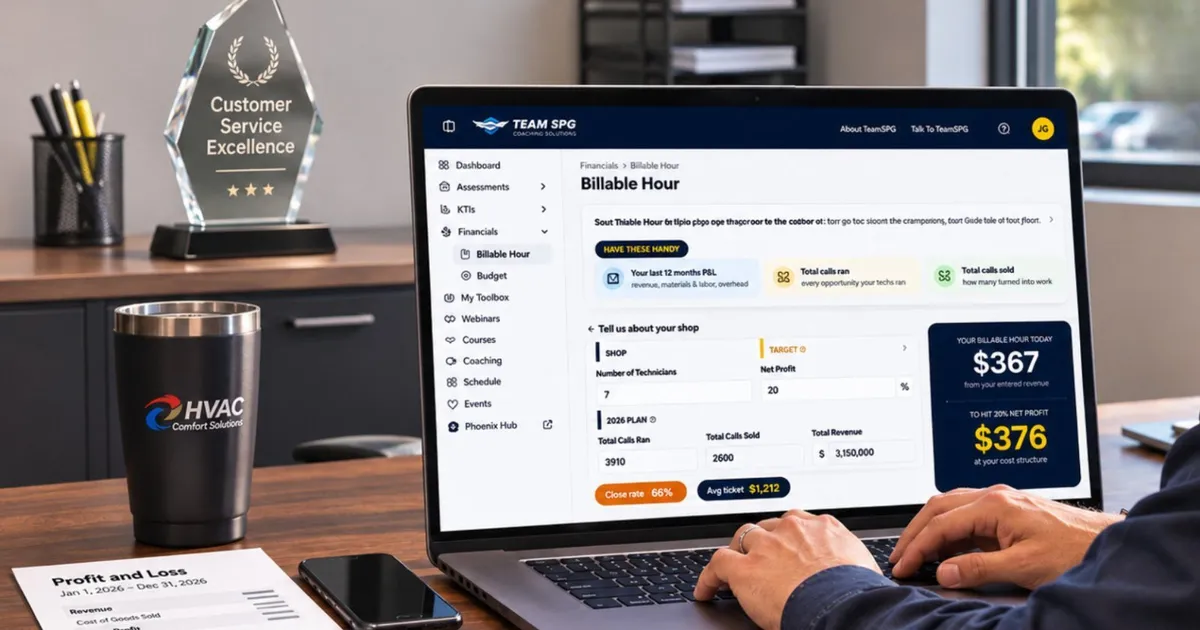
Your billable hour rate must cover your shop’s costs and leave your planned profit. Divide total yearly costs by one minus your profit goal, written as a decimal. Then divide by planned billable hours. Use hours your techs can bill, not every hour you pay them for.
How to Calculate Your HVAC Billable Hour Rate
The calculation below shows how to calculate hvac labor rate using your shop’s costs and planned billable hours. Use your shop’s worksheet to find the required revenue per billable hour.
We do not have your company’s costs or profit goal for a worked example. Pull your yearly budget rather than using a made-up company’s numbers.
- Required revenue = total yearly costs ÷ (one minus target net profit)
- Planned billable hours = tech count × yearly paid hours per tech × planned billable efficiency
- Required billable hour rate = required revenue ÷ planned billable hours
Start with the total costs from your yearly budget. Enter your profit goal as a decimal in the required revenue formula. The result covers those costs and leaves your planned net profit.
Next, use payroll records to find paid hours per tech. Use time records to compare billed hours with paid hours. That comparison gives you actual billable efficiency to review before setting your plan.
Divide required revenue by planned billable hours. If the rate seems too high, check the inputs with your coach. Do not lower the rate without showing how the revised plan covers costs.
Use Your Costs, Not a Competitor’s Price
A competitor’s rate tells you nothing about what your shop needs to make a profit. A shop with lower overhead may charge less and still make money.
Copying that rate could leave your revenue below your costs. Use your budget to calculate the rate. Then check actual costs and billed hours against that budget with your coach.
Calculate Your Rate Step by Step
- Add up your yearly costs. Include cost of sales, such as materials and field labor. Include all overhead, including office pay and truck costs. Include a fair salary for yourself without counting it twice.
- Include your profit goal. Divide total costs by one minus your target net profit, written as a decimal. This gives the revenue you need. Adding your profit percentage to costs does not give the same result.
- Calculate planned billable hours. Multiply your tech count by yearly paid hours per tech. Then multiply by planned billable efficiency. That is the share of paid hours your techs bill to customers.
- Divide required revenue by planned billable hours. The result is your required selling price per billable hour. Check that rate against the prices in your flat rate book.
Use the free Team SPG calculator to enter your own numbers. Bring the result to your coach with the budget that supports it.
Count Only Billed Hours
A tech is paid for a full day. But he does not bill a customer for all of it. Travel and parts pickup use paid time without adding billed hours.
Callbacks can also use paid hours without adding revenue. Track that time separately so your coach can see why billable efficiency changed.
Compare actual billed hours with your plan each month. If billed hours are below plan, review time records before assuming the selling price is wrong.
Keep Cost of Service Separate From Selling Price
Track cost of service per billable hour using your direct service costs. Keep the cost categories consistent so monthly comparisons mean something.
Your break-even rate covers total costs across planned billable hours. It includes overhead but leaves no planned net profit. Your selling price adds the revenue needed for your profit goal.
Ask your coach to review which costs belong in each calculation. Your budget and calculator must use the same cost categories.
Check Your Numbers This Week
- Pull your current budget and time records. Confirm total costs and actual billed hours. Identify any missing costs before using the calculator.
- Run the calculator and review the result with your coach. Compare the required rate with your flat rate pricing. Set a date to check actual profit against your goal.

Related questions
What Is Billable Efficiency?
Billable efficiency is the share of paid tech hours billed to customers. Calculate it by dividing billed hours by paid hours for the same period.
Should the Rate Include Materials?
This formula includes materials in total costs, so the result is a required revenue rate, not a labor-only charge. Have your coach check how your flat rate pricing covers materials so you do not count them twice.
Do I Need a Billable Hour Rate With Flat Rate Pricing?
Yes, your flat rate prices must cover required revenue across the hours your techs bill. Compare expected job revenue with planned billable time, using the same cost categories as your calculator.
How Often Should I Recalculate My HVAC Billable Hour Rate?
Check actual costs and billed hours against your plan each month. Recalculate when either changes enough to affect your profit goal. Review the revised rate with your coach before changing your flat rate book.